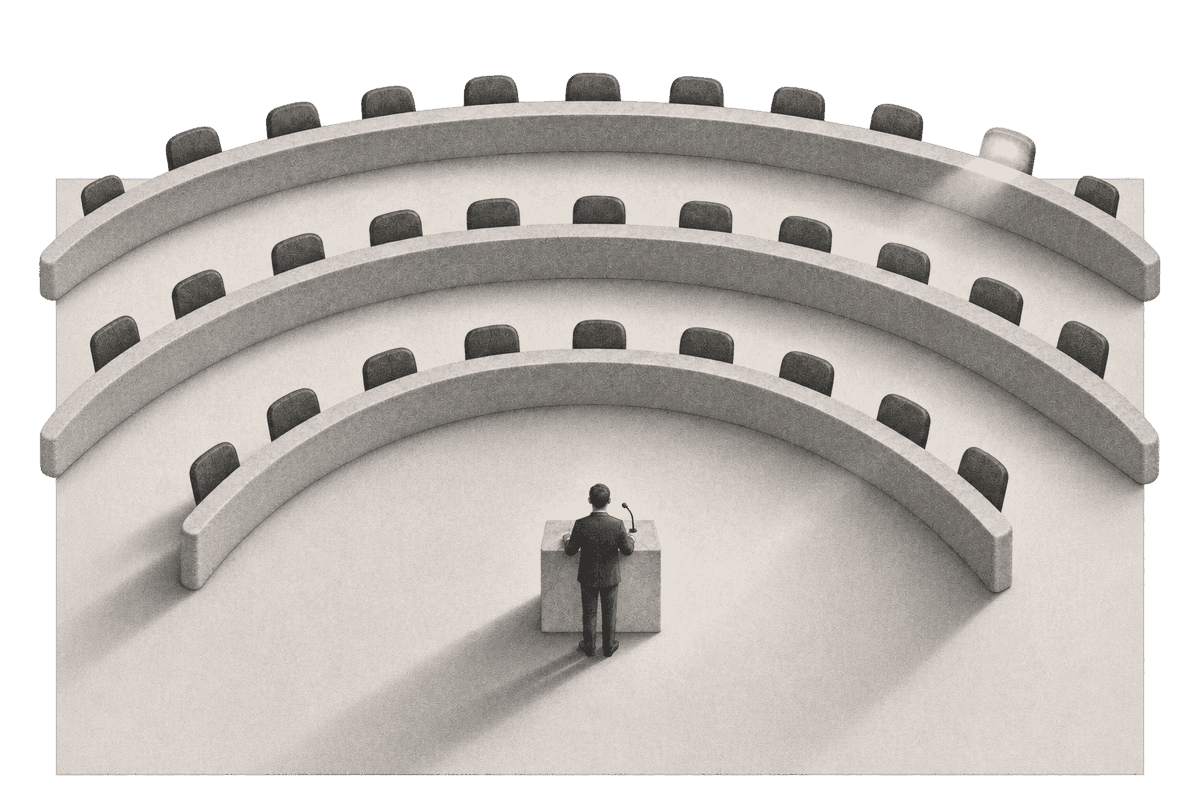
What if an AI governed us? Would there be less corruption? What would happen to partisan policies that do a country no good in the long run? In this issue I want to run a thought experiment on how a government led by AI could work.
Elections are coming up in Spain. There are several structural problems, like housing, social inequality and a polarised society, and they are the fault lines of the political breakdown we live in today.
As so many times before, voters will go to the polls and pick parties so they carry out their election promises.
The problem is that in Spain we have a system where deep change is hard, at least without an absolute majority. The system itself favours policies that make it grow, become more complex and more heavy.
On top of that, picking a party is full of nuance. When you vote for a party, you vote for a whole ideology, even if you don't fully agree with it.
One answer could be a system where we vote for projects rather than parties.
A party could put forward specific proposals, isolated, studied, each one solving a concrete problem. For this to really work, the proposals would have to be anonymous: we would stop judging the person behind them and focus on the proposal itself. Can you picture today's politicians having to make anonymous proposals?
Of course, there are many ways to tackle a problem, and without data, how do you choose? There would also be a flood of proposals. Which ones come first? Who decides? Who votes on them? Citizens? The leaders citizens voted for?
A lot of questions come up. To answer them we need to take a step back.
#(Dis)information
Democracy rests on the idea of an informed, proactive and engaged people who can consciously choose leaders to represent their interests and those of their nation.
In such a globalised world, with social networks and media that can polarise a population easily and automatically, I'm afraid democracy, as it was conceived, has run its course.
We have seen it recently: the British prime minister stated that Russia had interfered in the Brexit voteOpen in a new tab, misinforming voters through digital channels.
Do you think AI will make it harder or easier to manipulate people?
This doesn't mean I advocate for dictatorships or regimes. What I believe is that we need to evolve towards a different model.
#Digitalisation
Digitalisation has let us gather huge amounts of data. Information is vital to make decisions. I can't see any government making sound decisions without verified data. Today, any nation without a robust, interconnected way to collect data is flying blind.
When it comes to digitalising Spain, a few things are clear to me:
It makes no sense for every ministry, region or service to hold duplicated data. My identity as a citizen should live in one place. If an outside service needs to know something about me, I should have the power to accept or reject access to that specific piece of information. There should be no data collection forms. There should be only one. Every other system should ask that identity service.
And of course, every government system should be exposed through a REST API.
Every frontend should use a single design system.
Every system should be considered for open source, so citizens can propose improvements through pull requests.
It would be a system where not just anyone can make suggestions, and they could not be anonymous.
No more duplicated systems for each region.
A single login with passkeysOpen in a new tab. No Cl@ve, no Autofirma, no digital certificates, no passwords.
A system with all the information it needs could be proactive. It could tell you whether you qualify for a grant, a scholarship or an initiative. You wouldn't have to keep track yourself.
Your tax return would already be up to date.
Another interesting question: could we design a tax system where nobody needs to file a tax return?
These systems need to be in place so that an AI can extract trends, extrapolate data and propose improvements based on reliable information.
And people should have access to high quality digital services that are simple, approachable and make our lives easier.
#Governance
A government led by AI doesn't mean the AI could change legislation directly or would have programmatic access to launch nuclear weapons. It should receive information from verified sources, and there would be human guidance.
The AI could pick experts in different fields to carry out certain proposals and draw on their knowledge, bearing in mind that people tend to be corruptible. The goal, then, would be to design a system where corruption simply can't happen.
Let's take an example. The AI, through its many data gathering subagents, detects a rising trend in the price of trading cards. It identifies the experts who can help interpret that data. The committee analyses it and decides that tackling the problem is a priority. The committee meeting is transcribed and published. The AI runs several simulations to see what could improve the problem. After deep research, it proposes a change. The committee and the expert validate it and, if needed, ask the AI to amend it.
In this system, the data going in and the guidance given to the AI could be manipulated to serve the personal interests of the committee or the expert, so it would need to be audited.
#Conclusion
It's not a perfect system, far from it. There are many factors and pieces to weigh and define. How do we stop the committee from being corrupted? How do we avoid bias in the AI? Who builds or configures this AI?
Still, I think it could have many advantages:
- A huge reduction in government staff. There would be no politicians.
- It would prevent the manipulation and polarisation of the population.
- A more agile and effective government.
- A system that is harder to corrupt.
- Experts carry out proposals in their own field.
And you, what do you think?